Rhinoplasty • Brentwood, TN
Rhinoplasty, commonly called a nose job, is a surgical procedure that changes the shape, size, or function of the nose to improve facial balance or correct breathing problems. Dr. Ashley Guthrie is a fellowship-trained, double board-certified facial plastic surgeon in Brentwood, TN, who performs both cosmetic and functional rhinoplasty — including procedures to address dorsal humps, wide or bulbous tips, asymmetry, and deviated septums. Because the nose sits at the center of the face, even subtle changes can have a meaningful impact on overall facial harmony, which is why this procedure demands a surgeon who specializes exclusively in the face.
performed by a FELLOWSHIP-TRAINED FACIAL PLASTIC & RECONSTRUCTIVE SURGEON

Rhinoplasty (RECONSTRUCTIVE AND COSMETIC)
Rhinoplasty is a surgical operation that is performed to change or correct the shape and proportion of the nose, or to improve breathing through the nose. The procedure may be considered reconstructive when it is done to repair the nose from the effects of an injury, and cosmetic when it is performed for the purpose of aesthetic enhancement. While rhinoplasty can significantly improve the proportion and balance of the face, it is not suitable for treating signs of ageing on the face.
Injectable fillers, also known as "liquid rhinoplasty" or "non-surgical rhinoplasty", may be feasible for minor nasal sculpting that doesn't require reduction of any part of the nose. However, surgery is the only effective treatment if the goal is to make permanent and substantial changes to the nose shape, or to correct breathing issues.
open vs. closed rhinoplasty:
understanding the difference
Rhinoplasty is performed using one of two surgical approaches, and the right choice depends on the complexity of what needs to be corrected and the specific anatomy of your nose. Dr. Guthrie will recommend the appropriate technique based on your anatomy and goals during your consultation. The decision is always driven by what will produce the most accurate, lasting result for your specific nose.
OPEN RHINOPLASTY
An open rhinoplasty involves a small additional incision across the columella, the narrow strip of tissue between the nostrils. This incision heals to a barely visible line and gives the surgeon direct, unobstructed visibility of the nasal structures underneath. For more complex reshaping, significant tip work, or cases requiring cartilage grafting, the open approach allows greater precision and control.
CLOSED RHINOPLASTY
In a closed rhinoplasty, all incisions are placed entirely inside the nostrils, leaving no visible external scarring. This approach works well for patients with more straightforward goals, such as minor tip refinement or isolated dorsal hump reduction, and generally involves a shorter operative time and faster initial recovery.
who is a good candidate for rhinoplasty?
Rhinoplasty is one of the most individualized procedures in facial plastic surgery. The right candidate has both the right physical profile and a clear, realistic understanding of what surgery can achieve. Candidates generally include patients who:
Have a fully developed nasal structure — typically age 16 or older for women and 17 or older for men
Have specific cosmetic concerns such as a dorsal hump, a wide or drooping tip, nasal asymmetry, or overall proportions that feel mismatched with their other features
Experience functional problems such as breathing difficulty or a deviated septum
Are in good overall health with no conditions that affect healing or increase surgical risk
Are non-smokers, or are willing to stop smoking well in advance of surgery
Have realistic expectations — rhinoplasty refines and balances; it does not produce a different face
A note on revision rhinoplasty:
Patients who have had a previous nose job and are unhappy with their results, or who have developed functional issues following prior surgery, may be candidates for revision rhinoplasty. Revision cases are among the most technically demanding procedures in facial plastic surgery. Dr. Guthrie has revision rhinoplasty cases in her gallery and evaluates these patients individually at consultation.
WHY CHOOSE A FACIAL PLASTIC SURGEON FOR RHINOPLASTY?
The nose is one of the most technically demanding structures to operate on in the entire body. Millimeter-level changes affect both appearance and airflow, and mistakes are difficult to correct. This is why the surgeon's specialty training matters more for rhinoplasty than for almost any other cosmetic procedure.
Facial plastic surgeons complete their residency training in head and neck surgery, followed by a dedicated fellowship focused exclusively on the face. This means every procedure they perform, and every case they study, involves the nose, the surrounding structures, and the specific anatomy that rhinoplasty addresses.
Dr. Guthrie is double board-certified by the American Board of Facial Plastic and Reconstructive Surgery (ABFPRS) and the American Board of Otolaryngology Head and Neck Surgery (ABOHNS), credentials that reflect both surgical excellence and deep anatomical expertise in this region. For a procedure as precise as rhinoplasty, that level of specialization is not a bonus — it is the baseline.
how much does a rhinoplasty cost in nashville?
The cost of rhinoplasty in the Nashville and Brentwood area generally ranges from $8,000 to $18,000 or more, depending on the specifics of your case. Several factors affect where your cost will fall within that range: the complexity of the procedure (tip work alone versus full structural reshaping), whether an open or closed approach is used, whether cartilage grafting is required, and the experience level of your surgeon. Revision rhinoplasty cases typically carry higher costs than primary procedures, reflecting the additional technical difficulty involved.
It is also worth noting that functional rhinoplasty performed to correct a deviated septum or airway obstruction may be partially covered by insurance when medical necessity can be documented. The cosmetic component of the procedure, if combined with functional work, is generally self-pay. Dr. Guthrie's team can help clarify what may qualify for coverage at the time of your consultation. A personalized quote will be provided based on your anatomy and goals.
Rhinoplasty Before & After Gallery


Patient Before & After
- Before and After Rhinoplasty
Patient Before & After
- Before and 3 Months After Rhinoplasty with Chin Implant


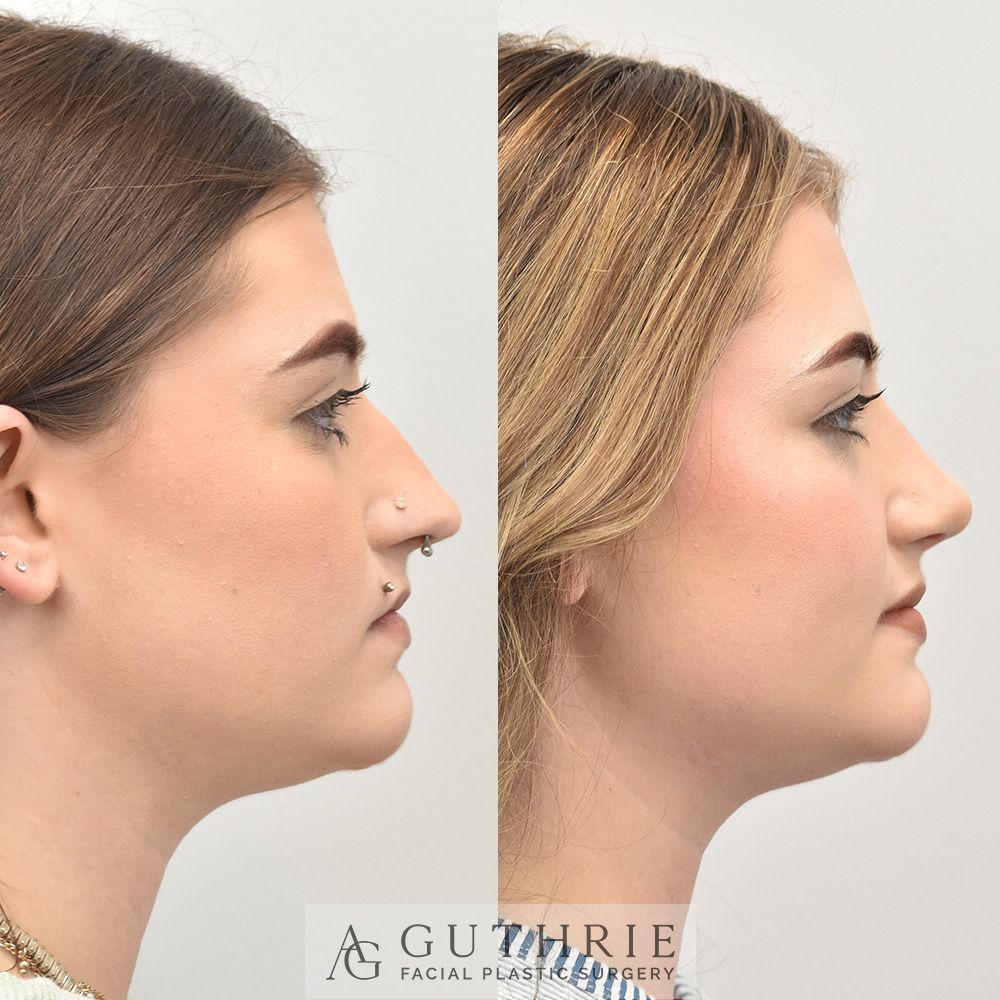


Patient Before & After
- Before and After Rhinoplasty
Patient Before & After
- Before and 1 Month After Revision Rhinoplasty


Patient Before & After
- Before and 6 Months after Rhinoplasty with Alar Base Reduction
Look like the best version of you
Ready to enhance your unique beauty? Call 615-880-9500 or click the button below to schedule a consultation with our expert Facial Plastic Surgeon, Dr. Ashley Guthrie.
View Real Patient Transformations
Visit Dr. Guthrie's Before & After Gallery to see real patient transformations for our most popular surgical treatments.
Frequently asked Questions
rhinoplasty Faqs
What can rhinoplasty correct?
Rhinoplasty can address a wide range of cosmetic and functional concerns, including a dorsal hump, wide or bulbous nasal tip, asymmetry, a deviated septum, breathing difficulties, and overall proportions that feel out of balance with the rest of the face.
How long is rhinoplasty recovery?
Most patients wear a nasal splint for about one week. Initial swelling subsides within 2–4 weeks, and patients can typically return to work within 1–2 weeks. Residual swelling, particularly at the tip, can take up to a year to fully resolve, though results are largely visible within a few months.
What is the difference between open and closed rhinoplasty?
In open rhinoplasty, a small incision is made across the columella (the skin between the nostrils), allowing full visibility of the nasal structures. Closed rhinoplasty uses incisions entirely inside the nostrils. Dr. Guthrie will recommend the appropriate approach based on the complexity of your case.
At what age can someone have rhinoplasty?
Most surgeons recommend waiting until nasal growth is complete — typically around age 15–16 for girls and 17–18 for boys. There is no upper age limit as long as the patient is in good health.
How much does rhinoplasty cost in Nashville?
The cost of rhinoplasty in Nashville varies based on the complexity of your procedure, the surgical approach used, and whether the case is a primary or revision rhinoplasty. Most patients can expect a range of $8,000 to $18,000 or more. Functional rhinoplasty performed to correct a breathing problem may be partially covered by insurance when medically necessary. Dr. Guthrie will provide a detailed, personalized quote during your consultation.
What is revision rhinoplasty?
Revision rhinoplasty is a secondary nose surgery performed to correct or refine the results of a prior rhinoplasty. Patients seek revision surgery for a variety of reasons, including residual cosmetic concerns, functional issues that developed after the original procedure, or results that changed as healing progressed. Revision cases are technically more complex than primary rhinoplasty because scar tissue and altered anatomy must be navigated carefully. Dr. Guthrie evaluates revision candidates individually and has revision rhinoplasty cases represented in her before and after gallery.
Will there be visible scarring after rhinoplasty?
For closed rhinoplasty, all incisions are placed inside the nostrils, so there is no external scarring at all. For open rhinoplasty, a small incision is made across the columella — the strip of skin between the nostrils. This heals to a fine, barely visible line in most patients and is not noticeable in normal social interaction. Dr. Guthrie uses meticulous closure techniques to minimize the appearance of any incision over time.